Black Mold Removal in Arvada, CO
The patch behind the washer in the basement laundry room was the size of a hand in January and the size of a cookie sheet by April, dark gray going black at the center, and it is on the drywall that backs up to the sump pit. You looked it up, read three pages about the worst cases, and stopped reading. This site connects you by phone with an independent local provider who does black mold removal in Arvada and across Jefferson County.
The color gets a photo; the moisture gets the plan
A dark patch does not change the sequence. The crew photographs it for your records and your adjuster, then goes looking for the water, because growth that dark on drywall has usually been fed for months. In a laundry room backed up to a sump pit the usual suspects are a pit lid that was never sealed, a discharge line that froze and split at the exterior wall in January, a washer hose, or a floor drain that backed up during the melt.
They meter the wall in a grid, not just over the stain, and read the slab around the pit and the bottom plate. A dark patch on the surface often marks the driest part of the problem; the wettest material is lower and farther along the wall. That reading, written down, is what sets the scope.
Do not scrape it, do not spray it, do not run a box fan at it
Leave the patch alone. Dry brushing or scrubbing a dark patch on drywall throws spores into the room, and a fan pointed at it carries them to the furnace return. Bleach darkens the surface and does nothing for the growth inside the board.
Close the laundry room door, shut the washer valves, photograph the patch and anything wet near it, and check the sump pit: if the water is near the top or the pump is silent, that is your source and it needs a plumber the same week. Anyone in the house with asthma or a weak immune system should stay out of that room until the crew has it under plastic.
Plastic up, wet drywall out, slab and framing cleaned
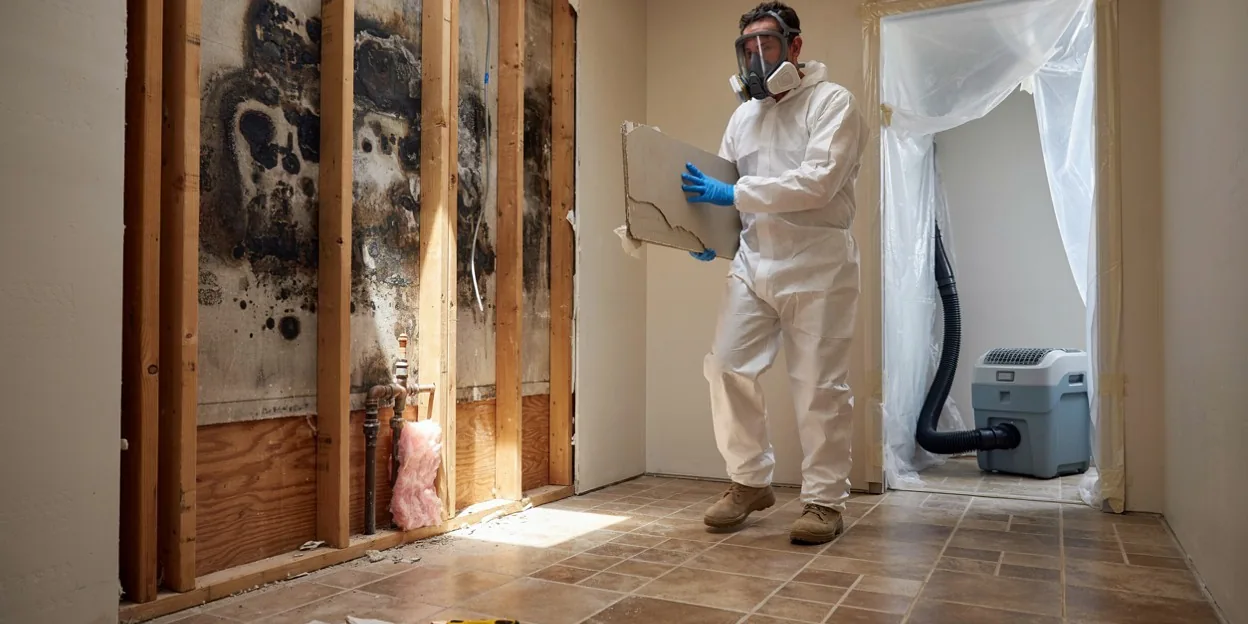
The laundry room is sealed with plastic, the furnace return in that corner is covered, and a HEPA scrubber runs under negative pressure. Drywall, insulation, and any wood trim with growth come out to the meter line and leave the house in sealed bags. Framing, the slab, and the foundation face are HEPA vacuumed, cleaned, and dried; wood with staining in the grain is sanded or treated, and the crew tells you which. Appliances that were in the room are wiped down inside the containment before they go back.
A dark patch on a bathroom ceiling follows the same steps under bathroom mold removal. If the pit overflowed and the whole lower level is wet, the job is whole-home mold remediation. A patch that has reached the furnace cabinet or the return duct is HVAC mold cleaning. The new drywall and trim are mold damage repair.
Sump pits, frozen discharge lines, and basements that never see daylight
Almost every Arvada house has a sump pit, because the clay here holds water against the foundation and a perimeter drain has to put it somewhere. The discharge line runs out through the rim joist and across the lawn, and when it freezes on a February night the pump runs against a closed pipe until it burns out or the pit overflows. The laundry room is usually the room next to the pit, with a slab floor, a window well for light, and a wall nobody looks behind.
Colorado has no mold license, so the provider represents its own training; a plumber replacing the pump or the discharge line is licensed through the state, and electrical work in the laundry room needs a City of Arvada permit. If a tenant, a buyer, or an insurer wants the species named, that is lab work you arrange separately with an assessor; the crews reached here do the removal, and the removal is the same whatever the name.
Describing a dark patch when you call
Have the address, where the patch is, roughly how fast it has grown, and what is wet or was wet nearby: the pit, a hose, a drain, a line through the wall. Say whether anyone in the house has breathing trouble so the crew plans the containment around them. Call (720) 823-6943.